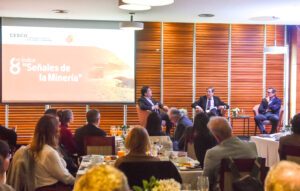
The Center for Copper and Mining Studies (CESCO) and the mining consulting firm Vantaz Group launched the 4th version of the study "Mining Signals" to analyze the expectations of different actors in the Chilean mining sector regarding the country and the industry, on key issues such as prices, demand, production, employment and investment.
Although industry expectations have improved with respect to April of this year, they are still in negative territory. In this regard, 78% of those consulted consider the current economic situation to be unfavorable, while 76.2% rate the social panorama as unfavorable and 52.3% disapprove of the regulatory environment.
When reviewing the dimensions associated with the industry, a deterioration in investment prospects is perceived, where 36.2% estimated that it will fall in the next two years, but in a horizon of 24 months, more than a third believe that it will decrease. "This could be due to the uncertainty generated by the discussion of regulations and environmental processes to develop mining projects", argues Daniela Desormeaux, Director of Studies at Vantaz Group.
The executive director of CESCO, Jorge Cantallopts, highlights a more optimistic view given that "in general the expectations of both the environment and the mining industry are better than those obtained in the previous version. However, this is still lower than the first time the study was done at the beginning of 2021, which would respond to the moment we are living as a country".
"Likewise, the expectations of both the economic and social situation are more auspicious in the medium term on the part of those surveyed, a situation that is not repeated when asked about the regulatory and environmental environment. This issue would remain stable in both the short and medium term," the executive added.
Price, investment and demand
Despite lower investment, there is greater optimism in the other factors measured. There is evidence of solidity in the price and demand. Thus, 58.4% of those surveyed stated that the price of copper will be maintained or increase, a perception that reaches 53.1% in the case of lithium and 44.6% in the case of iron.
In this sense, nearly 30% of the sample projects that the production of the red metal will fall in the short term, but believes that there will be a slight improvement in the next 24 months.
For mineral demand, 66.1% of those consulted estimated that worldwide demand will grow or remain the same in the next two years. When a similar query was made for lithium carbonate, 53.1% considered that demand will grow and another 12.3% that it will be maintained in two years.
Finally, the study sets out the main long-term challenges facing the local mining industry. Firstly, it mentions increasing competitiveness, followed by strengthening public institutions, unblocking exploration activity, and thirdly, having competent human capital. Further down the list is the issue of moving towards a mining industry with a lower carbon footprint, strengthening productive linkages at the local and national level and promoting greater inclusion and diversity in mining.
"The last point is a generalized trend in companies, not only in the mining world. Proof of this is the recent law being promoted by the government to increase the percentage of female directors in companies. Mining has already made progress in this over the last few years, so the respondents see that the challenge of promoting greater inclusion is already underway, and on the contrary, the biggest challenge today is related to competitiveness," added Desormeaux.

To see more